Tardigrades: the 'water bear' that survived the vacuum of space
They are smaller than a millimeter, live in the moss in your garden and can dry out almost completely to endure the impossible. What is true and what is hype.
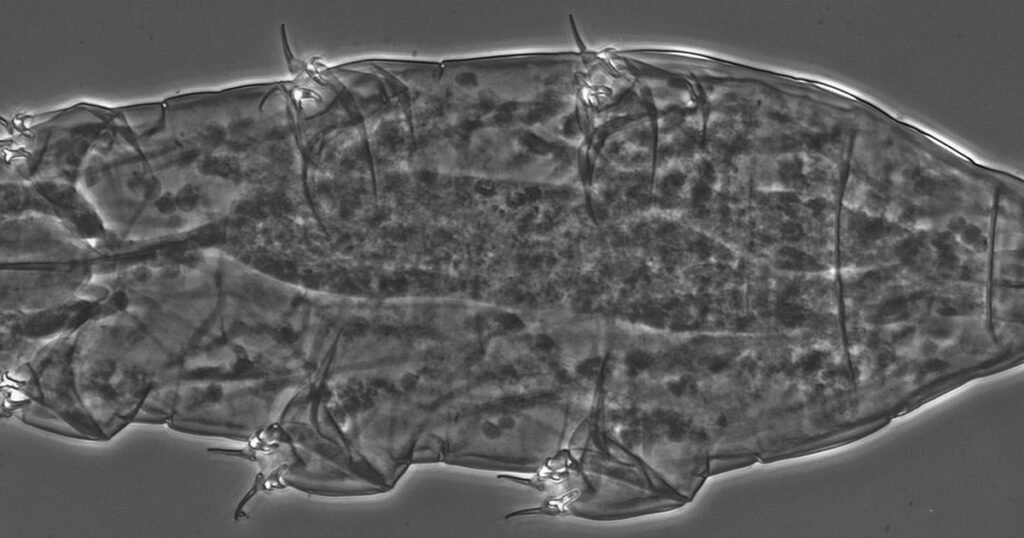
They have eight chubby legs with tiny claws, a body that looks like a small inflatable bear and a reputation straight out of science fiction. Tardigrades, also known as «water bears», are famous online as «the most indestructible animal on the planet». The reality is a little more nuanced, but no less astonishing.
What they are and where they live
Tardigrades are microscopic animals. Most are about half a millimeter long and the largest barely exceed a millimeter, so you need a strong magnifying glass or a microscope to see them properly. More than 1,300 species are known, and they live almost everywhere on Earth: in the sea, in lakes, in soil and, above all, in the thin film of water that covers mosses and lichens. There may well be tardigrades in the moss on a wall near your home right now.
They were first described in 1773 by the German pastor and naturalist Johann August Ephraim Goeze, who called them «little water bears». A few years later the Italian scientist Lazzaro Spallanzani gave them the name tardigrades, meaning «slow steppers», because of their unhurried way of walking.
The secret: drying out to stay alive
Their superpower is called cryptobiosis. When their surroundings dry up, many tardigrades pull in their legs, expel almost all the water from their bodies and shrink into a little ball called a «tun». In this state their metabolism drops to levels that are almost impossible to detect. When moisture returns, they rehydrate and within minutes or hours can start moving again as if nothing had happened.
To protect themselves while dried out, they produce special molecules. These include sugars such as trehalose in some species, and proteins unique to tardigrades that form a kind of gel or glass inside their cells, holding cell structures in place so they do not break apart.
All the way to outer space
In 2007 the European Space Agency sent tardigrades in the tun state into Earth orbit for about ten days aboard the FOTON-M3 mission. They were exposed to the vacuum of space and, in some cases, to solar radiation as well. Back on Earth, many of those exposed only to the vacuum recovered and even reproduced. Those that received the full ultraviolet radiation of the Sun fared much worse, but there were a few survivors. It was the first time an animal had been shown to survive direct exposure to space.
In 2016, Japanese researchers described a protein, named Dsup, in the species Ramazzottius varieornatus. When they introduced it into human cells grown in the lab, those cells suffered less DNA damage when exposed to X-rays. The finding generated interest in biotechnology, although it is far from becoming a medical application.
That same year, another Japanese team revived tardigrades that had been frozen for about 30 years in a sample of Antarctic moss collected in 1983. One of them even laid eggs after waking up.
What they are not: immortal
This is where fact and myth need separating. Tardigrades withstand extreme conditions mainly in the tun state and for limited periods. In their active form, while moving and feeding, they are fairly vulnerable: prolonged heat, for instance, can kill them relatively easily. And most live from a few months to a few years, not counting the time they spend «on pause».
Nor can they survive any impact. In 2019 the Israeli Beresheet probe crashed on the Moon carrying dehydrated tardigrades. A later study fired tardigrades at surfaces with a gas gun and found they do not survive impacts faster than about 900 meters per second. The probe hit much faster than that, so survival is very unlikely, and even if some had survived, without water or food they could not «colonize» the Moon.
Why they matter to science
Learning how tardigrades protect their cells could inspire new ways to store vaccines, medicines or biological samples without refrigeration, one of the big challenges in getting treatments to remote places. They also help astrobiologists think about the limits of life and what kinds of organisms might endure on other worlds.
How to find one yourself
If you have access to a simple microscope, give it a try: collect a piece of dry moss, soak it in rainwater or bottled water for several hours, squeeze the water into a clear dish and look patiently. With luck you will see a tiny «bear» lumbering clumsily among bits of leaves. It is a reminder that some of the most extraordinary creatures on the planet live, quite literally, under our feet.
Daniel Adrian Ciobanu, Krzysztof Zawierucha, Ioan Moglan, and Łukasz Kaczmarek. / Wikimedia Commons (CC BY 4.0) · source
For information only. It does not replace advice from a health professional. Medical disclaimer
You may also like
 Curiosities
Why do your fingers wrinkle in water? It is not what you were always told
 Curiosities
Salar de Uyuni: the salt desert that becomes the world's largest mirror
 Curiosities
Why do we yawn, and why is it contagious? (You will probably yawn reading this)
 Curiosities
Parícutin: the volcano that was born in a Mexican farmer's cornfield
 Curiosities
The Mandela effect: why millions of people remember the same thing… and are wrong
 Curiosities